A Question Of Truth - Chapter 49

Previously…
Apprehended in Radzicz, his papers seized and pistol confiscated, Johann remained confined in the constable’s house, awaiting Leutnant Krüger’s inquiry, burdened by past grief and the present danger of conscription.
*
The sun slanted through the grimy window, casting a thin line of bleak light across the rough floorboards. A church bell tolled from the distant steeple, echoing through the wet streets. Johann stirred, eyelids heavy, listening to the faint rhythm of the village awakening.
The constable’s wife stepped inside, carrying a tray. Her hands were warm from the kitchen, the faint scent of fresh herbs clinging to her clothes. “Your breakfast,” she said. “Bread, cheese, and broth again,” she said, a trace of apology in her voice. “I noticed you hardly touched anything yesterday. You should try to eat something, at least a little.”
Johann pressed his lips together, staring at the meager meal. Hunger gnawed at him, yet the thought of the Leutnant’s questions made it impossible to swallow.
“I… is anyone else here?” he asked cautiously, glancing toward the doorway.
She paused, setting the tray down. “Herr Falk and Leutnant Krüger are away on urgent business in Nakło,” she said. “There is a soldier posted just outside your door.” She lifted the ceramic water jug to check that it was still full, then glanced toward the window, noting the steady drizzle streaking the glass. “It’s Sunday and the church bells are ringing… I must hurry to service myself.”
Without waiting for Johann to speak, she stepped back into the hall, the bar sliding into place behind her with a low metallic click.
From somewhere down the hallway came the patter of small feet. “Quiet, Emil! Just a moment!” The Frau’s irritated voice rang out as the child’s laughter echoed briefly outside the door before fading.
Johann pressed his back against the wall, arms wrapped around his drawn-up knees. He listened to the steady drip of rain from the eaves and the occasional creak of shutters flapping in the wind, and the distant clop of hooves on muddy streets. In his mind, he pictured children happily splashing in puddles. Across the floor, the pale light shifted with the movement of the clouds, marking the slow passage of Sunday.
At last he sank sideways, the wall cold against his shoulder, until the pounding in his head and the ache in his limbs coaxed his eyes closed, caught in the uneasy sleep of one who knows he cannot leave.
A sharp rap on the door stirred Johann from fitful sleep. Startled at the intrusion, heart still thrumming from dreams he couldn’t quite recall, he struggled to sit upright as the bar slid aside and the guard stepped in, dust lifting where he walked.
“Bauer,” the man said, voice low. “Herr Falk won’t be back for a while, and Leutnant Krüger was delayed in Nakło.”
Frau Falk appeared in the doorway on the guard’s heels, carrying a tray. The warm scent of freshly baked bread and the faint smoke from the hearth drifted from the kitchen as she set it down. “Breakfast,” she said, glancing at him, before turning away.
With the room empty once more, Johann paced in his stockinged feet, scarcely glancing at the tray. The aroma pulled him back for a moment to his mother’s kitchen at home… the constant chatter of his siblings, the soft crackle of the hearth. A memory so ordinary, yet so distant, that it stung to recall. He ran a hand over the rough wall, exhaling sharply, before being drawn back into the barren room to wait for whatever came next.
By Monday evening, Johann had paced the floor more times than he could count. His shoulders ached, and the stiff floorboards pressed uncomfortably against his feet. He paused at the window, eyes closed as he pictured a ship—its wide deck open to the wind, waves lapping somewhere below, the sharp scent of salt carried on the breeze. He had heard travelers speak of the creak of timbers and the sway of the sea. In his mind, the passage would carry him beyond this suffocating room, toward a life waiting somewhere past the water, uncertain yet unmistakably his own.
He sank onto the sagging bed at last, weary beyond measure. Johann stirred little through the night, exhausted from restless sleep trapped by his own thoughts. Morning light crept through the window as he dozed fitfully, dreams filled with ships and distant seas, waking to muffled sounds outside—the creak of a pump, a hen’s brief outcry, the steady rhythm of an axe striking wood.
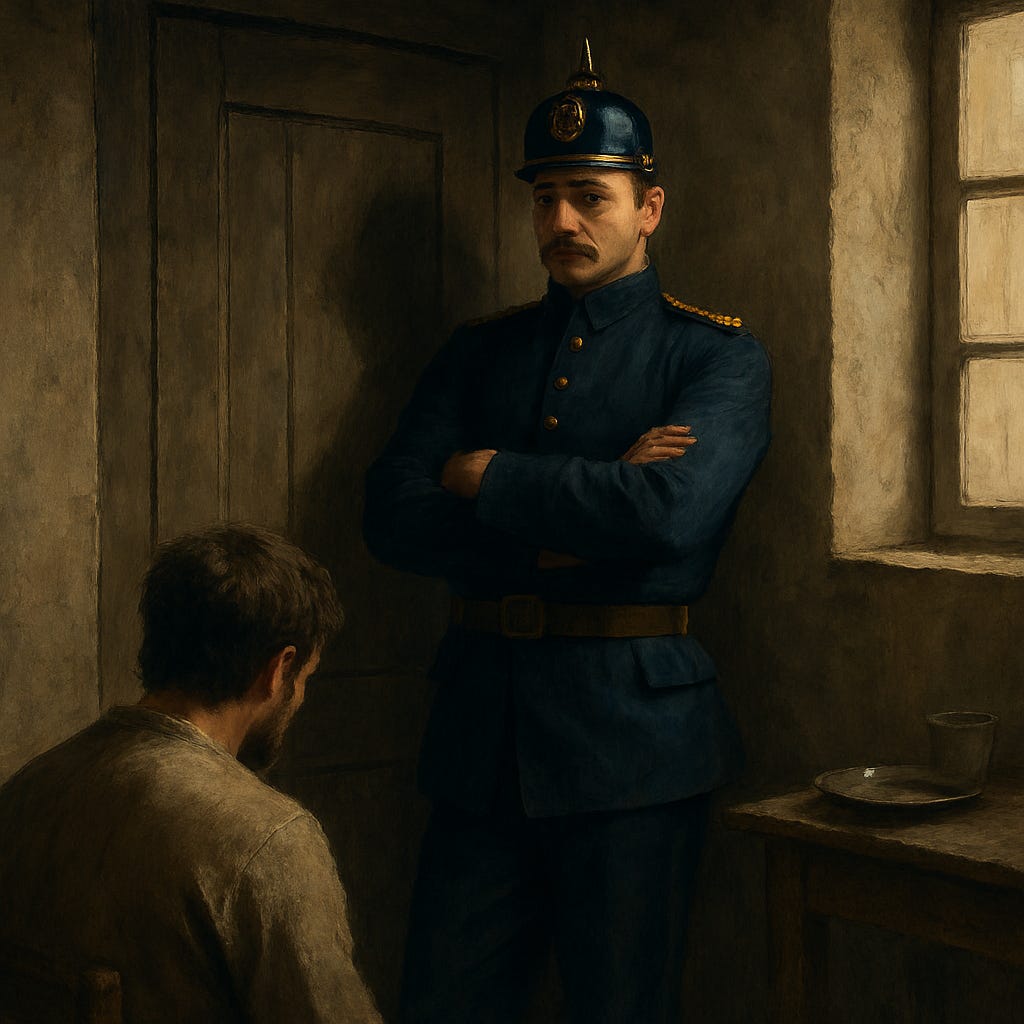
Late Tuesday afternoon, Johann stiffened at the sound of hurried boots echoing down the hall, voices urgent but indistinct. The door rattled slightly with each step. A heavy rap struck the wood, followed by the creak of the hinges, announcing the guard’s arrival. He held the door ajar as Leutnant Krüger stepped through, eyes darting briefly to Johann.
“On the stool, Bauer. Setzen!”, the Leutnant snapped. Johann obeyed, every nerve alert.
The guard immediately moved behind Johann and pressed a firm hand to his shoulder, the faint scent of leather and sweat close.
The officer’s sharp eyes swept the room, settling on Johann with a mix of curiosity and contempt. “You’ve had quite a journey, haven’t you?” he said at last, his speech deceptively mild. “Your papers say Bremen. Passage to America.”
Johann said nothing.
The Leutnant stepped closer, boots creaking on the boards. “Curious detail, though—a man on his way to a new life doesn’t usually carry a pistol.” He held the weapon between thumb and forefinger, turning it in the light. “Not something a farmer keeps by his bedside.”
He let the words linger, then asked more quietly, “Where did you get it?”
Johann’s throat tightened. “It—it was found,” he managed.
The officer tilted his head, voice sharpening. “Found. Where?”
Johann tugged at the end of his mustache, eyes fixed on the floor. “By the road… east of Bromberg,” he mumbled.
“By the road? Alone?” Krüger’s eyes narrowed, his tone carrying disbelief. “And no one else witnessed you find it?”
Johann swallowed hard. “I—I was traveling… alone,” he whispered.
Leutnant Krüger leaned back against the door, arms crossed. His leather belt creaked, punctuating the silence.
“Tell me, Bauer, what business carried you along this road?”
Johann hesitated, fingers fidgeting with his mustache. Each question felt like a trap, yet the words tumbled out before he could stop them.
“It… it was Caroline. She was—she was taken.” He pressed a hand to the back of his neck, damp with sweat.
The Leutnant’s brow lifted, one corner of his mouth curling slightly. “Taken?”
“Yes,” Johann said quickly. “Three soldiers. I only wanted to find her… to make sure she was safe.” A nervous cough escaped him. “She’s my sister.”
The officer’s brow furrowed, his tone coaxing. “And did you find her?”
Johann’s pulse pounded in his temples. “I don’t know… if she lived.”
The Leutnant shifted his weight, still leaning against the door. “You don’t know if you found her—or you don’t know if she lived?” His voice was calm, but the question landed like a blade. “You speak as though you saw her and yet somehow did not. Explain yourself, Bauer.”
Johann hesitated, throat parched. “We came upon her wagon,” he said at last. His voice wavered. “Might I… have a cup of water?”
Krüger gave a curt nod, never taking his eyes off him. The guard poured from the clay jug and handed Johann the cup. He drank, his hand trembling around it.
Johann’s gaze stayed fixed on the cup in his hands, fingers tightening around the rim.
“You said ‘we’ just now, Bauer. Earlier, you claimed you were traveling alone. Which is it?” The officer’s voice was calculated, each word measured to unsettle.
Johann shifted uneasily, his grip loosening on the cup as he struggled to steady his breathing.
“You were alone when my men stopped you.” Krüger picked up the pistol again, turning it slowly in his hand, his eyes never leaving Johann. “So, who was with you before that?”
Johann’s fingers brushed the end of his mustache. “Might I have another?” he asked, nodding toward the jug.
Krüger adjusted the pin on his chest, eyes fixed on Johann as he motioned to the guard. The man poured again—slower this time.
Johann drank, stalling for a few precious seconds before setting the cup down, hand trembling as it met the table. “A friend,” he said finally. “He was helping me look for her.”
Leutnant Krüger tilted his head. “A friend,” he echoed softly. “And this friend—does he have a name?”
Johann hesitated. “Karl,” he said finally, the name faltering on his lips.
The officer’s expression didn’t change, but something sharpened behind his eyes. “Karl.” He repeated the name as if tasting it, then filed it neatly away. “And where is this Karl now?”
Johann wet his lips. “I don’t know… we—he and I got separated.”
“In the chaos of searching for your sister—the same sister… what did you say her name was? Caroline?” Krüger’s voice was calm, but his words cut sharply.
Johann exhaled, trying to steady himself. “Yes. It all happened fast.”
Leutnant Krüger’s sharp eyes held Johann’s. “And this Karl—how is it you know him?”
Johann shifted on his stool. “We… I met him along the way.”
Krüger’s tone remained calm, but his eyes narrowed. “Along the way? Explain. Why was he with you? Did he know about your sister?”
“I… I don’t know,” Johann admitted, voice tight. “He wanted only to help.”
The officer leaned closer, one hand adjusting the brim of his hat. “Only wanted to help? Did he see what happened to her? Or was he merely accompanying you?”
Johann’s fingers clenched the edge of the table. “He… he didn’t see, sir. He wasn’t there when…”
Krüger straightened, brow furrowing. “And yet you speak of ‘we found the wagon.’ So, he was there?”
Color drained from Johann’s face.
The Leutnant studied him for a long, quiet moment. “How very tragic,” he murmured. The floorboards creaked beneath his weight.
Johann drew a quick breath, lips parting as though to speak, then closing again.
The officer pushed away from the door, his tone measured. “Mm. I see. And this sister of yours… Caroline, you said? You state you don’t know if she lived?”
“No… I—I don’t.” He shifted on his stool, hands gripping his knees.
Krüger walked slowly to the window, hands clasped behind his back, mulling over Johann’s answers. The guard’s fingers drummed lightly against the leather of his holstered pistol.
The officer turned to face Johann, eyes sharp, voice almost conversational. His forehead creased. “Curious thing, Bauer. Earlier, you told my men you were traveling to Remscheid for your sister Caroline’s first birth.”
He took a step closer. “Yet now you say soldiers took her—and you don’t know if she survived?”
Johann’s stomach tightened, a icy knot of dread forming.
The officer’s gaze held him fast. “Bauer, explain this: how does a sister, dead or alive, give birth in Remscheid when you last saw her east of Brombeck?”