Alone - Chapter 48

Previously…
Johann was seized outside the tavern in Radzicz. His horse bolted, his papers were confiscated, and a pistol was found in his haversack. Now he waits in a locked room at the constable’s home—for questioning, and whatever fate the Leutnant may bring.
*
The bed at the constable’s home, lumpy with straw, groaned beneath him as Johann turned for the third time, unable to find rest. The night had been long, and every sound — a rat scuttling across the floor, the drip of rain from the roof, the creak of the shutters in the wind — drew him from sleep. Hunger gnawed at him, but it seemed a small matter compared with the fear pressing like a stone upon his heart.
He clung to the thought it was only a matter of hours until the Leutnant arrived. Only hours. Yet the thought brought little comfort. He pictured the officer’s stern, deliberate gaze and imagined the worst: conscription, imprisonment… or perhaps even some fate he dared not name.
And then there was the gun. Questions would surely come—how had a farm boy like him come by such a weapon? He knew enough to understand it was dangerous in more ways than one: it had belonged to a soldier, and no explanation could justify having it. Carrying it had been a mistake.
He pressed his fingers against his scalp as the full weight of his plight settled upon him.
I might never see you again, Mama. You’ll be left forever wondering what became of me.
He startled at the soft knock at the door, followed by the shuffle of feet. The constable’s wife, her apron streaked with flour, set a small tray upon the rough table: bread, a wedge of cheese, and a mug of thin broth.
“Frau… how long must I stay here? Will someone come for me soon?” His words were little more than a strained whisper.
She glanced at him, her expression unreadable. “It’s Saturday,” she said gently. “Nothing will be done until Monday at the earliest, and even then the Leutnant has other matters to attend to. Sometimes it takes longer. You must make yourself ready to wait.”
Johann pressed his lips together, shoulders slumping. He faced the gloomy room with nothing but his own fearful thoughts.
“Danke, Frau,” he mumbled, staring at the meager meal. She gave a small nod before stepping back into the shadows of the hallway.
The door thudded behind her; the bolt sliding across with a metallic click that echoed in the small room. Johann lowered himself onto the narrow bed, the straw shifting beneath him. He stared at the dreary ceiling above, the tension in his neck and shoulders a premonition of the questions and judgment yet to come.
Through the thin walls, muted voices drifted from outside—the rattle of a cart over rough stones, a horse’s low whinny, a dog barking somewhere down the lane—while he sat, perhaps with no hope of finding his own place in the world.
Johann curled onto his side, drawing his knees close, hands gripping them until his knuckles throbbed. He pressed his eyes shut, each breath faltering.
Surely you must be awake now, Mama, fretting over me—so much time has passed without word. Or perhaps you believe I am already aboard the ship, beyond peril. You cannot know I am here, shut in this room, awaiting a stranger’s judgment.
He turned his face to the wall.
You laid it all out—my chance to escape.
He sat up suddenly, bent over his knees, pressing his face in his hands.
I wanted to help… do what I thought Papa would have done. Each of them—Caroline, Oskar, Matthias, Heinrich—needed me. Every stop, every pause, time I should not have spent.
He dragged his hands down his face and let his head fall back against the cold timber wall, the chill seeping through to his shoulders and back.
Will I die in service as Michael and August did? You couldn’t shield them… yet you believed you could spare me.
Wracked with worry, Johann shifted forward on the bed, his feet dropping to the floor. The meager bread, cheese, and broth on the table turned his stomach. He glanced toward the haversack lying nearby, the flask of vodka Jakob had pressed on him inside. For a moment he considered it, but what comfort could it possibly bring?
And the rest of the family—would Adolf, Mina’s husband, be spared? With three young mouths to feed at home? And Peter, Juliane’s husband, only months wed—would they take him so soon, before they even had children?
Johann snatched the small tin flask from his haversack and drank in one gulp. The sharp burn raced down his throat, settling in his belly like fire. He set the flask on the table, cursing under his breath.
“Danke, Jakob.” Turning it over in his hand for the first time, he noticed the large dent in its side. Teeth clenched, he leaned back on the bed, bracing against the sudden heat.
He shook his head, pressing his palms against his eyes, his jacket folded for a pillow.
I was but five when Papa said Michael wouldn’t be coming home… around the large wooden table with Mina, August, Juliane, Robert, and little Samuel--the clamor when the ladle slipped from your hand, stew spilling across the table. Your face did not look right.
He picked up a piece of bread, holding it tightly in his hand before setting it down. The day Michael had departed… it was rainy, like today.
Johann pushed himself up from the bed and crossed the sparse room. Rain traced crooked lines down the windowpane, blurring the view through its warped, old glass. He leaned his forearms on the sill, staring out at the gray street.
A few figures hurried past, cloaks drawn tight against the drizzle, boots splashing through the puddles. A cart creaked slowly over the cobblestones; its driver hunched beneath the rim of a wide-brimmed leather hat.
Johann turned, slumping against the wall near the window, a faint musty smell clinging to the rough planks in the damp air. He wondered how many others had waited in this room before him. His gaze dropped to the floor, but his thoughts strayed elsewhere—another supper, another night when Papa had news.
Exhaling deeply, Johann tugged irritably at his mustache. Almost three years ago this month.
Papa was late for supper, and I was so hungry. When he finally came in and sat down, the house fell silent—he only stared out the window. “August… he won’t be coming home.” Juliane was crying. Theodore and Max, sitting without talking across from me, and Bertha squirming on the bench. You held little Margarete close, a tear sliding down your cheek. Your hands were trembling.
Johann dropped onto the stool near the window. I felt guilty for being hungry.
Suddenly Johann clenched his fists as his mother’s tears came to mind. “How many, God?” he breathed through his teeth as faces and ages blurred together.
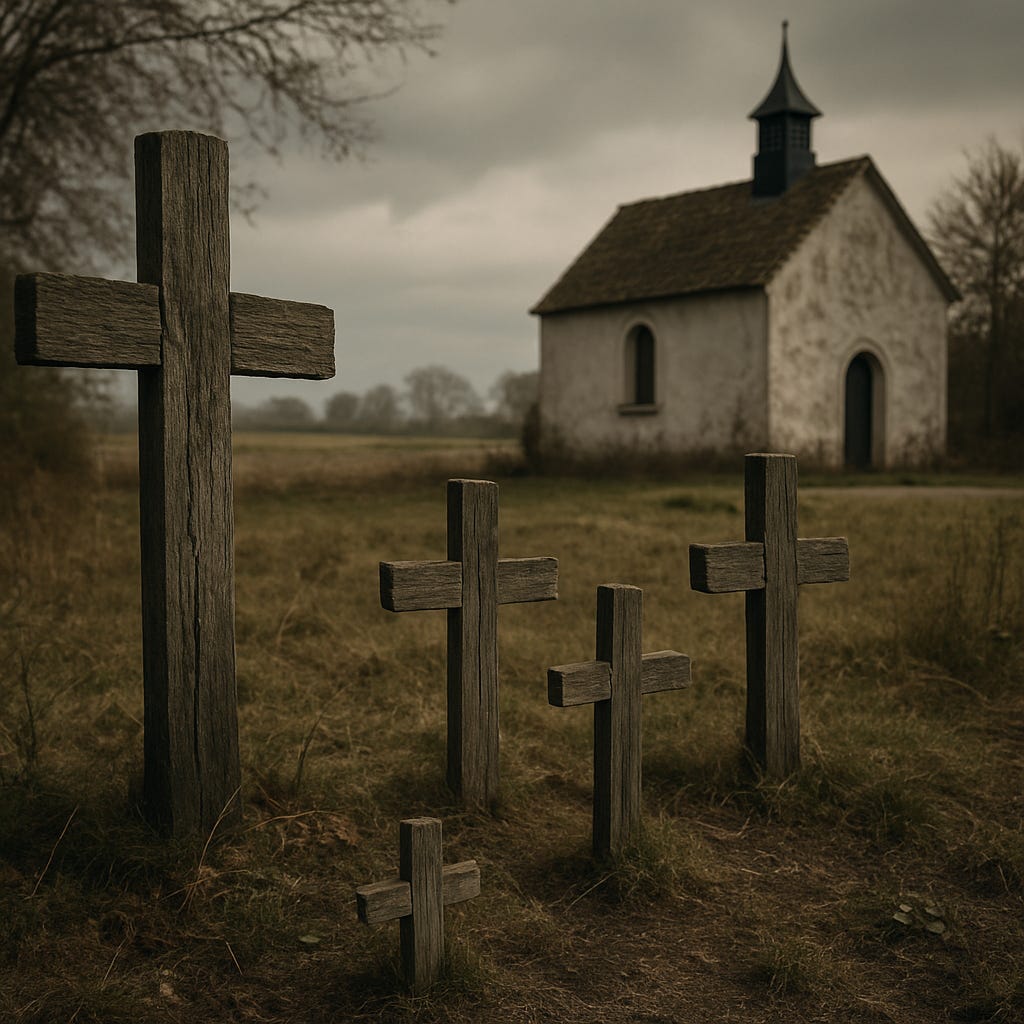
Michael, August, little Sammy at three, Robert at eleven, Samuel at five. The babies who hadn’t even been named. All those tiny graves. How many? Was it six?
…Then, you too, Papa.
It’s been a year already, and I still…
The thought struck like a blow. There was always so much to do--someone had to keep the fields turning, the house fed. And you weren’t there. I tried, Papa. God’s truth. I plowed the fields, tended the animals, and kept bread on the table. I did it. I did all of it.
The inn… I should never have stopped. Schwarz needed water, yes— but all signs told me otherwise. I failed.
And now here I am—the one who was supposed to escape, to carry their hopes across the sea—locked in a room.
Johann slammed his fist on the table as rage and grief surged through him. The crack of wood echoed in the room; the stool rattling with the force. A stifled sob tore from him as he pressed his palms to his face.
He startled at the sharp rap on the door. A concerned voice called through the wood, “Is everything all right in there?”
*
Author’s Note: When Johann’s father’s first wife died, he was left with five children, ranging in age from approximately nine to one, while managing a farm. Two months and five days later, he married Johann’s mother, then twenty-six.
This chapter reflects the larger family Johann grew up with, including the children of his father’s first wife, who died at the age of 35. It also highlights customs of the time, such as naming a subsequent child after one who had died, which explains the two Sam’s in the story.
Young men in Prussia were often conscripted into service even during periods without active war, and deaths occurred not only in battle but from disease or accident, as was the case with Michael, the oldest of Johann’s brothers. August died in the Austro-Prussian War of 1866, one of the conflicts surrounding Prussia during this period. Johann’s mother’s insistence that he leave ahead of the war of 1870 is the result of having lost two sons already.
These details illuminate the world Johann inhabited, the stakes for his family, and the pressures he faced as he attempted to navigate his own path.