
North Sea - Chapter 62

Previously…
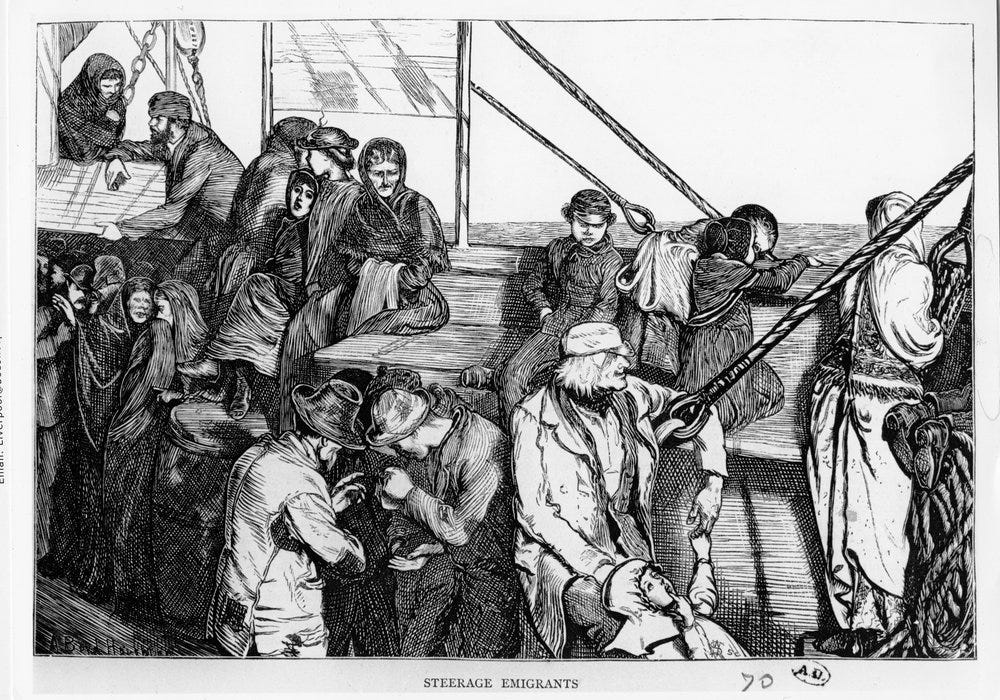
After his damaged papers passed a second inspection, Johann followed the others up the gangway and boarded the Union. He was directed into steerage, where bunks filled quickly and the air grew close. As the ship put out to sea the next morning, Johann lay awake listening to the rush of water against the hull. The young man in the bunk nearby picked up their conversation.
*
“Paul,” the man said, adjusting the bundle under his head.
“Johann,” he said, pushing himself up on his elbow to meet Paul’s eyes.
He lay back again, the wood rough against his back. The vibration ran steady beneath him, a low working sound through the timbers.
Somewhere along the compartment, a man laughed sharply. A hacking cough followed, then a muttered curse. Footsteps passed overhead, heavier than before.
“You ever been on a ship?” Paul asked.
Johann shook his head. “No. Only the river.” He paused. “A few days ago, steamer.”
“You’ll feel it more once we’re clear of the harbor,” Paul said. “Or less. Depends who you ask.”
Johann lay still. “You’ve been on one, then.”
“Often. Southampton,” he said. “Family there.”
Johann nodded, swinging his legs over the edge of the bunk. He bent and pulled on his boots, the thrum deeper beneath his feet. Close by, someone snored.
A crewman passed without stopping. The air stirred as he went, lifting the damp, sour smell that clung low in the compartment.
Johann drew a breath, on the verge of standing. He shifted, his back stiff, his stomach hollow in a way that had nothing to do with hunger.
Voices began to rise and fall, men speaking over one another, asking the same few questions repeatedly. Something clattered to the floor, followed by a brief burst of laughter.
“How long to Southampton?” a man called out.
“Long enough,” someone answered, and a murmur went through the men.
Johann listened, then glanced toward Paul. “You stopping there?”
Paul reached for his boots. “Ja. Only that far.”
From the bunk above, a man with a graying beard leaned partway over the edge. “Family there?”
Paul looked up. “Uncle.”
“Mine too,” Johann said. “An uncle. Homestead.”
The bearded man leaned back slightly. “Georg,” he said. “New York. Son’s there.”
Paul drew his legs in as someone passed.
Talk drifted on as people stirred awake, then broke off as an unmistakable sound cut through the space.
Someone was heaving. A bucket scraped along the floor as it was dragged. A man swore.
There was no place the sound didn’t reach.
The smell followed.
Johann drew a breath and wished he hadn’t.
“God help us,” Georg muttered, lifting his sleeve to his face. “Air’s got to be better topside.”
Paul glanced toward the stairs. “If they’re letting people up.”
Johann hesitated. “We can’t just… go up?”
Paul rose, shrugging. “Not always.”
A loose cluster of men stood at the foot of the stairs, a few with hands near their mouths, all of them facing the same way. Others leaned back against the bulkhead, faces gone pale.
One man stepped out of the group and went up the stairs. No one moved to stop him.
A cool current of sea air drifted down the stairs.
“Bucket!” someone called, and more men edged toward those already gathered at the foot of the companionway.
Johann hauled himself upward behind Paul and Georg, one hand on the rail, the stairs more ladder than steps.
Light widened ahead of him. As they emerged, a crewman glanced their way and turned back to his work.
At the railing, Johann looked out over broken water. The sea below cut into short, hard-edged waves, the ship driving through them rather than riding over. The water lay dark beneath the gray sky; the horizon blurred where sea and cloud met.
Paul leaned on the rail. “North Sea,” he said. “Always looks like this in winter.”
“Better than down there,” Georg said, filling his lungs with the cold air.
The wind turned on them, fouled suddenly with coal smoke spilling back from the funnel. Georg coughed and turned away.
Johann moved clear of the smoke with the others; a shoulder brushed his as men and women pressed toward cleaner air, the deck already crowded.
On the other side of the ship, he heard a woman cry out. She leaned into the wind, gripping the rail with one hand, the other on her bonnet as the gust worried at her skirts.
A faint bell sounded from below, barely carrying over the noise.
Some men turned toward the stairs.
Paul straightened. “That’ll be food,” he said.
Georg leaned close to Paul’s ear. “Ja.”
Johann glanced back to find Paul and Georg already moving with the others, and fell in behind them. As they went down, the air turned warm and used, the lingering reek of sickness not yet gone, the smell of cooking grain rising.
A line was already forming along the aisle, tins and cups in hand.
Johann looked again. All men.
Paul and Georg stopped at their bunks, each taking up a tin.
Johann paused, twisting the end of his mustache.
“You got a cup?” Georg asked, glancing back.
“No,” Johann said. “I didn’t—”
Georg reached back for a tin, knocking it against the boards before pressing it into Johann’s hand.
The line bent around the bunks and posts, stopping and starting as men shifted to make room. The man behind Johann leaned in, breath warm at his neck.
When his turn came, the crewman at the front of the line dipped the ladle and tipped it into Johann’s tin. Mostly hot water, thin with grain, the cup scarcely filled.
He followed Paul and Georg back, edging past the line, careful with the tin as it grew hot.
Johann sat on the edge of the bunk, feet planted as the ship almost shuddered underfoot, making room without looking as Georg paused, then sat.
The heat spread through Johann’s chest as he tipped the tin and swallowed.
He looked up to see Paul run a finger around his empty tin before wiping it clean with his sleeve.
Johann lifted his brows. “No water?”
Paul shrugged. “Does well enough.”
Johann glanced at Georg.
Georg shook his head with a faint smile. “You’ll get used to it.”
Johann looked down at his own sleeve, then wiped his tin clean. He rubbed the wool between his fingers; it was damp and sticky.
He held the tin in his lap, hesitating.
“Keep it,” Georg said.
Johann placed it where it wouldn’t roll, his hand slow to let go.
Georg wiped his beard with the back of his hand and climbed back up to his bunk.
“How long’s your son been in New York?” Johann asked.
“Since ’63,” Georg said, his voice carrying down.
“You going to stay?” Johann asked.
A man’s foot brushed Johann’s leg as he hurried past, cursing under his breath. He pulled his feet in and lay back, the ship’s vibration rougher than before.
“Ja,” Georg said, finally. “I’m alone now.”
Johann closed his eyes. The ship groaned around him, a low working sound carrying through the hull.
Paul glanced toward the stairs. “No sense lying here yet.”
The sound of Georg’s breathing, already deepening, drifted down.
Paul shifted. “I’m going back up. You coming?”
Johann opened his eyes and swung his feet down. “Los.”
Pulling his coat close, he stood. “Ja. Let’s go.”
They came up into the wind and moved away from the stairhead toward the rail, where fewer people lingered now. A man ahead tugged his hat lower, bracing his feet as the deck lifted.
Paul leaned on the rail and pointed toward the water. “See there.”
Johann followed his gaze. A low, dark hull moved across the gray at a distance, a broken line of white stirring behind it.
“Trader,” Paul said.
Farther off, another ship shouldered through the sea, heading back toward the coast, its water breaking heavy along its sides before it passed from sight.
The wind drove hard across the deck. A young mother drew her two sons close and steered them back toward the stairs, heads bent against the wind.
Paul looked up. “Gets cold quick.”
A sailor passed behind them, unhurried, collar turned up, knit cap pulled down tight.
Paul shifted his weight, watching the crewman. “I nearly signed on the year before.”
Johann turned his head, shielding his eyes, a question half-asked in his mouth, but the wind took it.
The smoke tore away faster now, flattened by a wind that needled through wool and cotton.
Others were turning back toward the stairs. Johann looked to Paul who nodded, already moving.
They went back down the stairs, shoulders easing as the warmer air took hold, coats coming loose, voices rising around them. Johann followed Paul along the narrow passage, bodies brushing past in lantern light.
Paul slowed. Johann looked past him up to Georg’s bunk.
It was empty.
Sounds like a brutal, hard life but as Georg says, Johann will get used to it. Your writing flows so well. It takes me no time to read it. Excellent, Colleen.
Colleen, you really feel the cramped steerage, the brief relief on deck, and the small ways people look after each other. That ending lingers in a quiet, unsettling way.